Vernier caliper least count
On this page
The least count of a vernier caliper is the smallest length it can read: one main-scale division divided by the number of vernier divisions, which on the usual vernier is the difference between one main-scale division and one vernier division. On metric calipers it is usually 0.1 mm, 0.05 mm or 0.02 mm. This guide gives the formula, shows why it works, and works through ten problems of the kind set in exams.
Least count formula
LC = value of 1 main-scale division ÷ number of vernier divisions
On the usual (short) vernier: LC = 1 MSD − 1 VSD
MSD is one main-scale division and VSD one vernier-scale division. The least count is also called the vernier constant (VC). The first formula holds for every vernier. The second gives the same answer on the usual vernier, whose n divisions are made exactly as long as n − 1 main-scale divisions; on a long vernier it becomes 2 MSD − 1 VSD. For example, on a caliper with 1 mm divisions and a 50-division vernier, LC = 1 mm ÷ 50 = 0.02 mm.
Why the formula works
Close the jaws and look at the two zero lines: they sit exactly together. Now look at the end of the vernier. On a 0.1 mm caliper its 10 divisions fill 9 mm of the main scale, so its last line meets the 9 mm line.
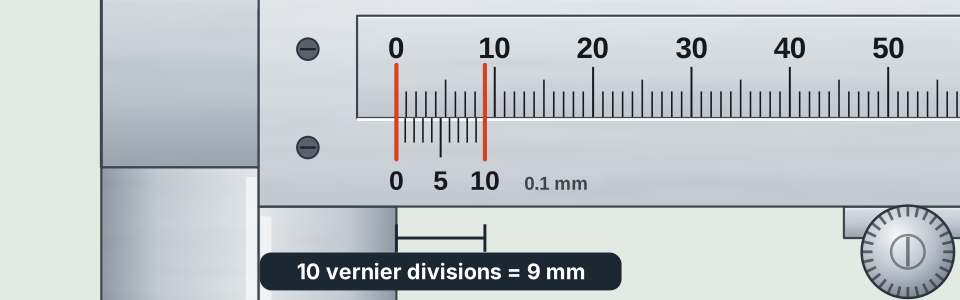
So each vernier division is 9 ÷ 10 = 0.9 mm, which is 0.1 mm shorter than a main-scale division. With the jaws closed, vernier line 1 sits 0.1 mm short of the 1 mm line, line 2 sits 0.2 mm short of the 2 mm line, and so on. Open the jaws by 0.1 mm and line 1 moves onto the 1 mm line.
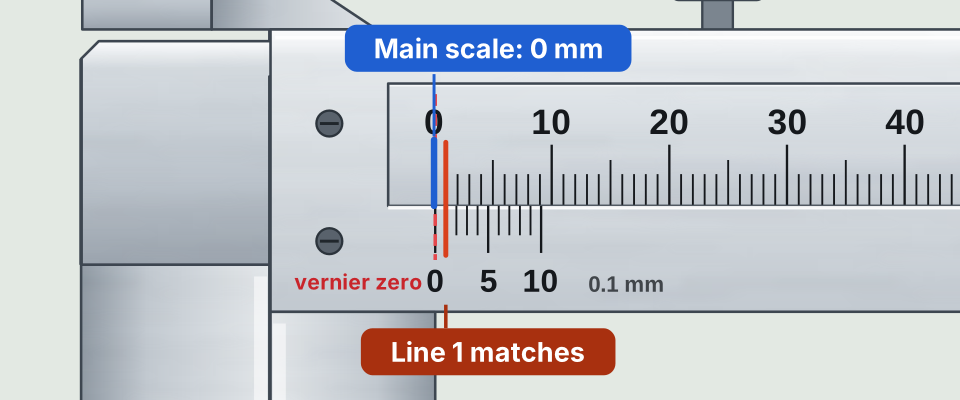
Open them by 0.2 mm and line 2 lines up; by 0.7 mm and line 7 does. The number of the matching line counts how many least counts the jaw has moved past the last main-scale line. That is why a reading is the main scale reading plus the matching line number times the least count.
Least count of common vernier calipers
The same rule gives every caliper's least count. The finer the least count, the more vernier divisions fit in.
| Caliper | 1 MSD | Vernier divisions | They fill | 1 VSD | Least count |
|---|---|---|---|---|---|
| Metric, 0.1 mm | 1 mm | 10 | 9 mm | 0.9 mm | 0.1 mm |
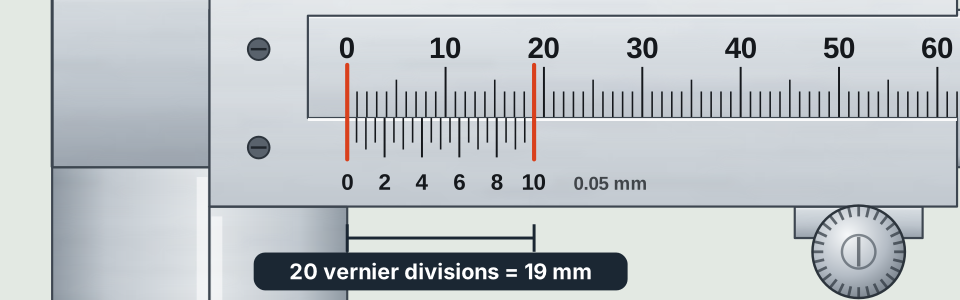
| Metric, 0.05 mm | 1 mm | 20 | 19 mm | 0.95 mm | 0.05 mm |
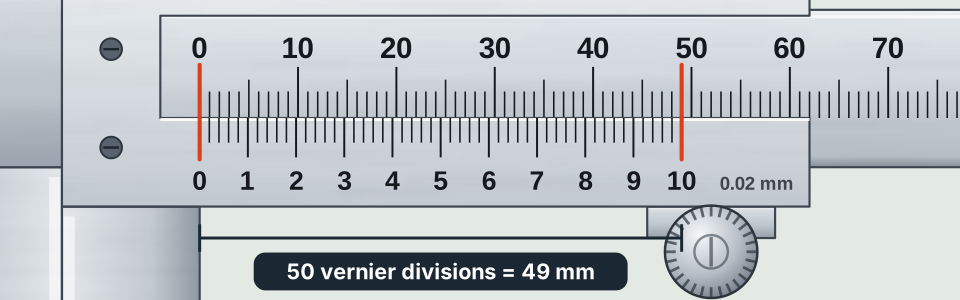
| Metric, 0.02 mm | 1 mm | 50 | 49 mm | 0.98 mm | 0.02 mm |
| Decimal inch | 0.025 in | 25 | 0.600 in | 0.024 in | 0.001 in |
| Fractional inch | 1/16 in | 8 | 7/16 in | 7/128 in | 1/128 in |
| Metric, 0.1 mm, long vernier | 1 mm | 10 | 19 mm | 1.9 mm | 0.1 mm |
| Metric, 0.05 mm, long vernier | 1 mm | 20 | 39 mm | 1.95 mm | 0.05 mm |
| Decimal inch, long vernier | 0.025 in | 25 | 1.225 in | 0.049 in | 0.001 in |
In centimetres the least counts are 0.01 cm, 0.005 cm and 0.002 cm: the same lengths, written in a larger unit.
Long verniers: LC = 2 MSD − 1 VSD
Some calipers spread the vernier lines out so they are easier to see. Each vernier division is then a little shorter than two main-scale divisions instead of one. On a 0.05 mm long vernier, 20 divisions fill 39 mm, so 1 VSD = 1.95 mm.
Long vernier: LC = 2 MSD − 1 VSD = 2 − 1.95 = 0.05 mm
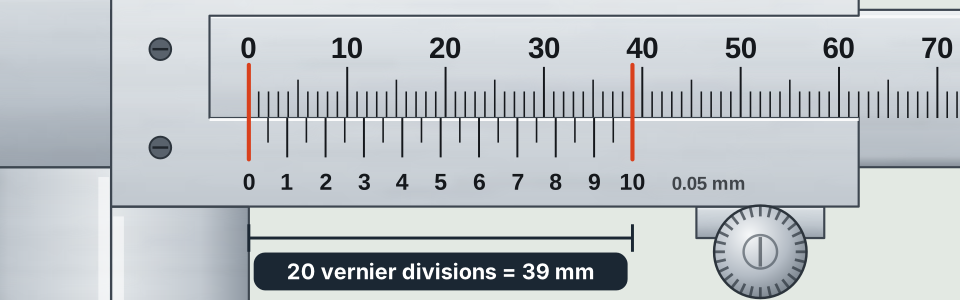
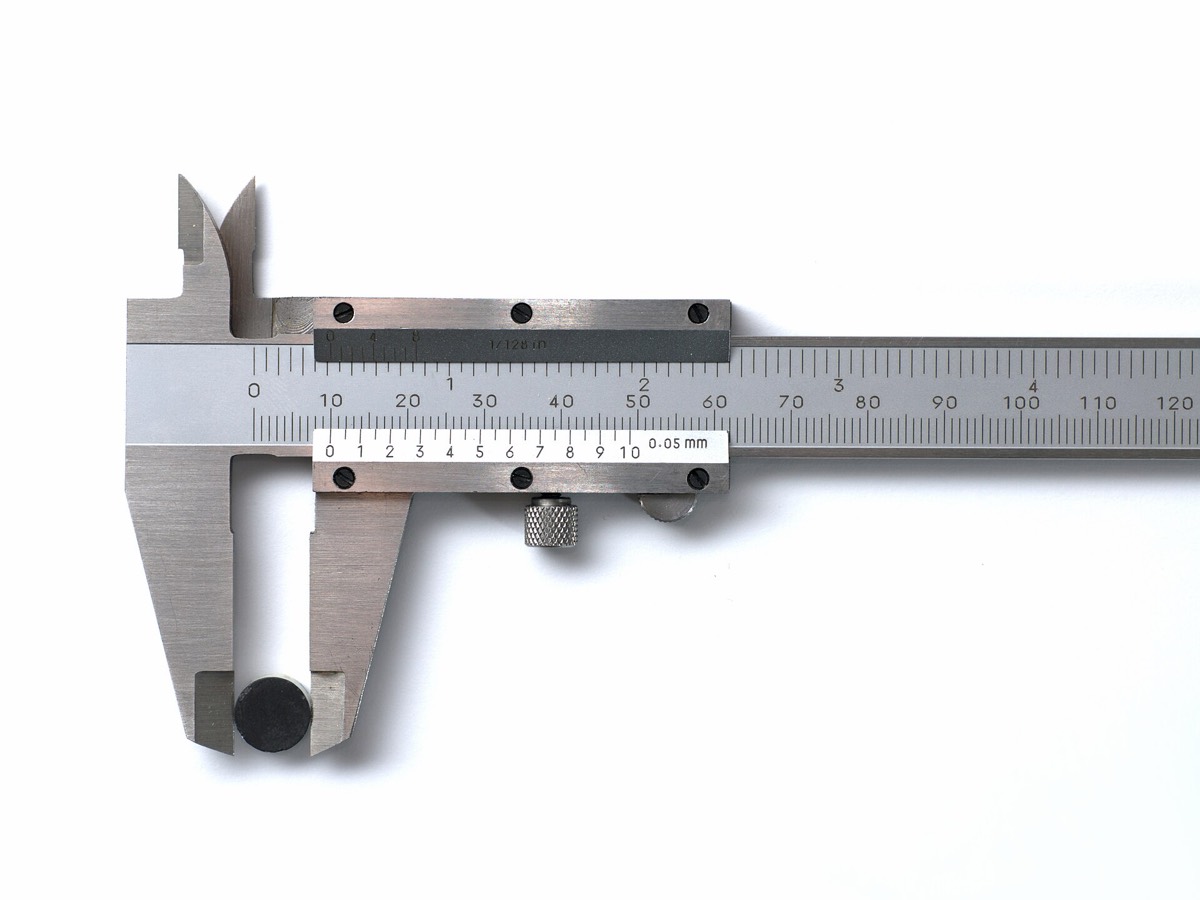

The least count and the way you read the caliper are exactly the same as on a short vernier. Only the spacing changes.
How to find the least count of your caliper
- Find the value of one main-scale division. It is the gap between two neighbouring lines on the beam: usually 1 mm, sometimes 0.5 mm, or 0.025 in or 1/16 in on an inch caliper.
- Count the vernier divisions. Count the spaces from the vernier’s 0 line to its last line. Do not go by the printed numbers: on a 0.02 mm vernier a number appears only every 5 lines, and the number 1 stands on line 5.
- Divide. Least count = one main-scale division ÷ number of vernier divisions.
- Check. Most calipers have the least count engraved on the vernier plate, for example “0.02 mm”. Your answer should match it.
Solved examples
The main scale is in millimetres, and 10 vernier divisions are equal to 9 main-scale divisions. Find the least count.
10 VSD = 9 MSD, so 1 VSD = 9 ÷ 10 = 0.9 mm.
LC = 1 MSD − 1 VSD = 1 − 0.9 = 0.1 mm.
A caliper has 1 mm main-scale divisions and a vernier of 20 divisions that fills 19 mm. Find the least count.
1 VSD = 19 ÷ 20 = 0.95 mm.
LC = 1 − 0.95 = 0.05 mm. Check: 1 mm ÷ 20 = 0.05 mm.
50 vernier divisions coincide with 49 main-scale divisions of 1 mm each. What is the vernier constant?
1 VSD = 49 ÷ 50 = 0.98 mm.
Vernier constant = 1 − 0.98 = 0.02 mm.
Each main-scale division is 0.5 mm, and 25 vernier divisions equal 24 main-scale divisions. Find the least count.
1 VSD = 24 × 0.5 ÷ 25 = 0.48 mm.
LC = 0.5 − 0.48 = 0.02 mm. Check: 0.5 mm ÷ 25 = 0.02 mm.
On a long vernier, 20 vernier divisions span 39 mm of a main scale with 1 mm divisions. Find the least count.
1 VSD = 39 ÷ 20 = 1.95 mm, a little less than 2 MSD.
LC = 2 MSD − 1 VSD = 2 − 1.95 = 0.05 mm. Check: 1 mm ÷ 20 = 0.05 mm.
A caliper with 1 mm main-scale divisions has a least count of 0.02 mm. How many divisions does its vernier have, and how long is it?
n = 1 MSD ÷ LC = 1 ÷ 0.02 = 50 divisions.
They fill 50 − 1 = 49 main-scale divisions, so the vernier is 49 mm long.
The main scale is numbered in centimetres, with 10 divisions to each centimetre, and 10 vernier divisions equal 9 main-scale divisions. Find the least count in centimetres.
1 MSD = 1 cm ÷ 10 = 0.1 cm. 10 VSD = 9 MSD, so 1 VSD = 0.09 cm.
LC = 0.1 − 0.09 = 0.01 cm, which is 0.1 mm.
A decimal inch caliper has 40 main-scale divisions to the inch and a vernier of 25 divisions. Find the least count.
1 MSD = 1 ÷ 40 = 0.025 in.
LC = 0.025 ÷ 25 = 0.001 in.
A fractional inch caliper has main-scale divisions of 1/16 in and a vernier of 8 divisions. Find the least count.
LC = 1/16 in ÷ 8 = 1/128 in.
A caliper with a least count of 0.1 mm shows a main scale reading of 24 mm, and vernier line 6 matches. Give the reading in millimetres and in centimetres.
Reading = MSR + (VSR × LC) = 24 + (6 × 0.1) = 24.6 mm.
In centimetres: 2.46 cm.
Using the least count in a reading
Reading = main scale reading + (matching vernier line × least count)
Write every reading to the least count. On a 0.02 mm caliper, a reading of 27.50 mm keeps its last zero: it shows the reading was taken to 0.02 mm, while 27.5 mm would suggest only 0.1 mm. The step-by-step reading guide works through a full example, and the zero error section shows how to correct a caliper whose zero lines do not meet.
Least count is not accuracy
The least count tells you how finely the scale can be read, not how close the reading is to the true size. That also depends on the condition and calibration of the caliper, how squarely and gently it is held, and the temperature of the part and the instrument. A 0.02 mm caliper is not automatically accurate to 0.02 mm.
Practise on each least count
Each link opens a round of five reading questions on that scale in the simulator.
Questions about least count
What is the least count of a vernier caliper?
It is the smallest length the caliper can read: one main-scale division divided by the number of vernier divisions, which on the usual vernier is the difference between one main-scale division and one vernier division. Metric vernier calipers commonly have a least count of 0.1 mm, 0.05 mm or 0.02 mm; inch calipers 0.001 in or 1/128 in.
What is the formula for the least count of a vernier caliper?
Least count = value of one main-scale division ÷ number of vernier divisions. On the usual vernier, whose n divisions fill n − 1 main-scale divisions, this equals 1 main-scale division − 1 vernier-scale division; on a long vernier, whose divisions are each a little shorter than two main-scale divisions, it equals 2 MSD − 1 VSD.
What is the least count of a vernier caliper in cm?
The same length in a different unit: 0.1 mm is 0.01 cm, 0.05 mm is 0.005 cm, and 0.02 mm is 0.002 cm.
Why is the least count also called the vernier constant?
Because it is fixed for a given caliper. It depends only on how the main scale and the vernier are divided, not on what is being measured, so the same value is used for every reading taken with that instrument.
Does a smaller least count mean a more accurate caliper?
Not by itself. The least count says how finely the scale can be read. How close a reading is to the true size also depends on the condition and calibration of the caliper, how it is held, and temperature.