How to read an inch vernier caliper
On this page
An inch vernier caliper is read exactly like a metric one: the main scale reading, plus the matching vernier line times the least count. Only the divisions differ. Decimal inch calipers read to 0.001 in; fractional ones to 1/128 in. This guide works through two examples of each.
The decimal inch scale (0.001 in)
The main scale has 40 divisions to the inch, so each small division is 1 ÷ 40 = 0.025 in. The large numbers mark whole inches and the small numbers tenths of an inch (0.1 in), with 4 small divisions in each tenth. The vernier has 25 divisions, so the least count is 0.025 ÷ 25 = 0.001 in. Its numbers 0, 5, 10 … 25 count vernier lines.
reading = inches + tenths + (small divisions × 0.025) + (matching line × 0.001)
Decimal example 1: 1.081 in
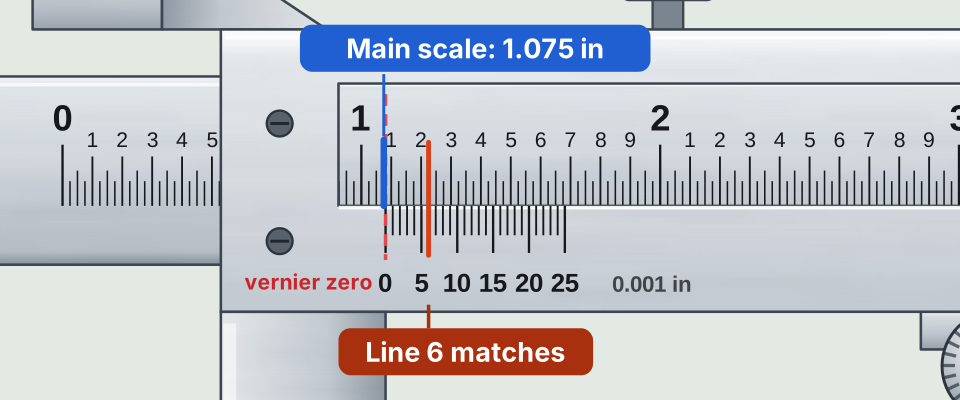
- The vernier zero has passed 1 in, 0 tenths and 3 small divisions: 1 + 0.000 + (3 × 0.025) = 1.075 in.
- Vernier line 6 lines up with a main-scale line: 6 × 0.001 = 0.006 in.
- Reading = 1.075 + 0.006 = 1.081 in, which is 1.081 × 25.4 = 27.4574 mm. As a reading, write 27.46 mm: the caliper reads to 0.001 in, about 0.025 mm, so the digits after the second decimal place mean nothing.
Decimal example 2: 2.347 in
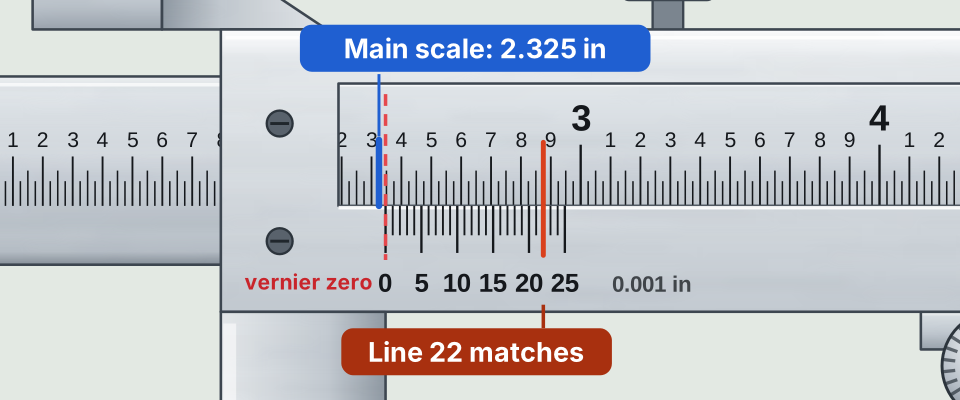
- The vernier zero has passed 2 in, 3 tenths and 1 small division: 2 + 0.300 + (1 × 0.025) = 2.325 in.
- Vernier line 22 lines up with a main-scale line: 22 × 0.001 = 0.022 in.
- Reading = 2.325 + 0.022 = 2.347 in, which is 2.347 × 25.4 = 59.6138 mm. As a reading, write 59.61 mm: the caliper reads to 0.001 in, about 0.025 mm, so the digits after the second decimal place mean nothing.
The fractional inch scale (1/128 in)
The main scale has 16 divisions to the inch, so each is 1/16 in. The vernier has 8 divisions, so the least count is 1/16 ÷ 8 = 1/128 in. To add the two parts, write both in 128ths: one sixteenth is 8/128.
reading = main scale (in 16ths) + (matching line × 1/128), then reduce the fraction
Fractional example 1: 1 5/64 in
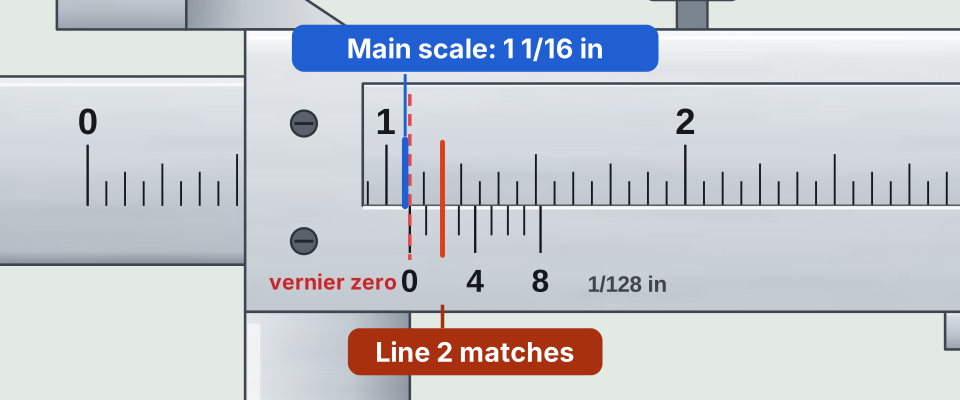
- The vernier zero has passed 1 1/16 in: 1 inch and 1/16, which is 1 8/128 in.
- Vernier line 2 lines up: 2 × 1/128 = 2/128 in.
- Add in 128ths: 1 8/128 + 2/128 = 1 10/128 in.
- Reduce: 1 10/128 = 1 5/64 in.
Fractional example 2: 2 23/128 in
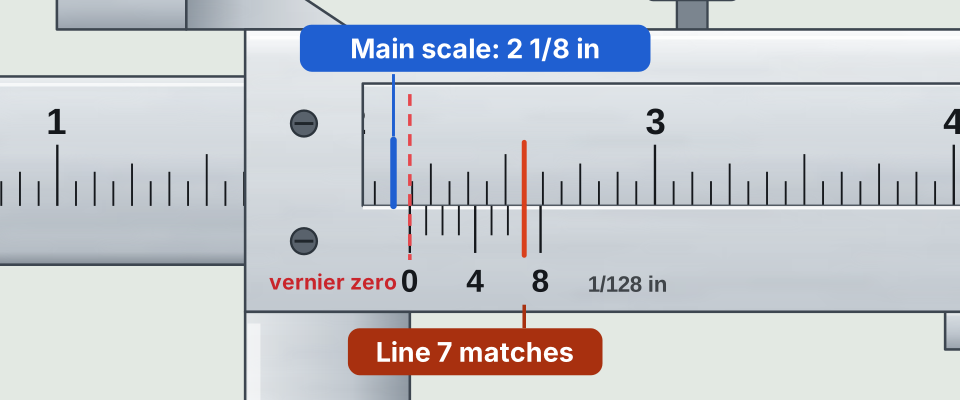
- The vernier zero has passed 2 1/8 in: 2 inches and 2/16, which is 2 16/128 in.
- Vernier line 7 lines up: 7 × 1/128 = 7/128 in.
- Add in 128ths: 2 16/128 + 7/128 = 2 23/128 in.
- 23/128 is already in lowest terms, so the reading is 2 23/128 in.
Calipers with both scales
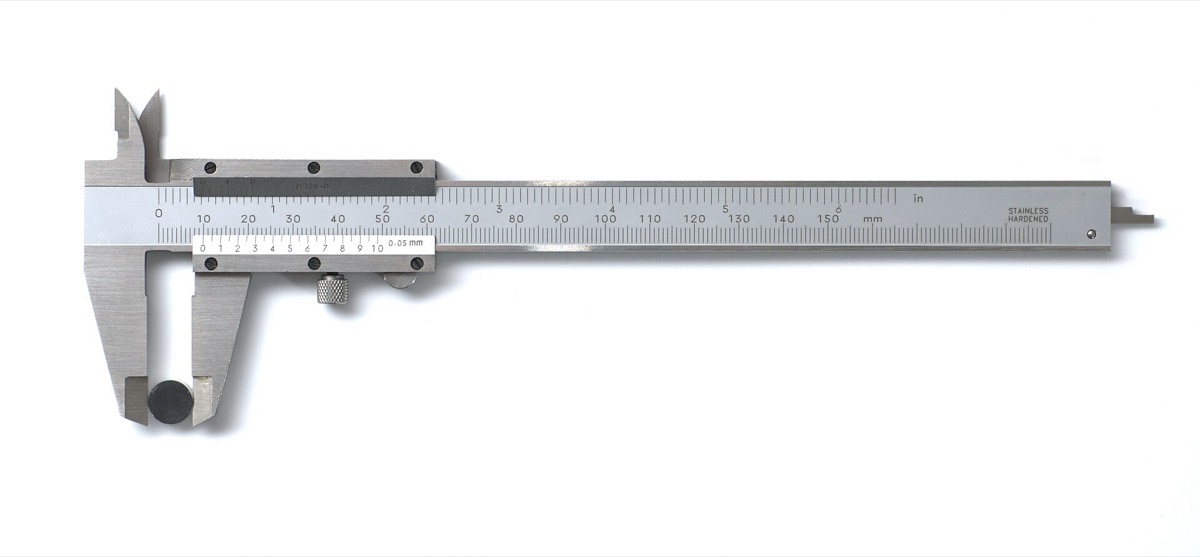
Many calipers carry a metric scale and an inch scale on the same beam, each with its own vernier. Read the pair that matches the unit you need, and use only that pair's least count.

Mistakes to avoid
- Reading the small numbers on a decimal main scale as whole inches. They are tenths: the 3 after the 1 is 1.3 in.
- Forgetting the small 0.025 in divisions after the last tenth, or counting them as 0.01 in.
- Taking a line on the fractional vernier as 1/64 in or 1/16 in. Each line adds 1/128 in, so line 7 adds 7/128 in, not 7/64 or 7/16.
- Adding sixteenths and 128ths without putting them over the same denominator, or leaving the answer unreduced.
- Reading the inch vernier against the metric main scale, or the other way round, on a caliper that has both.
Practise inch readings
- Read a 0.001 in caliper: a round of five.
- Read a 1/128 in caliper: answers as fractions in lowest terms.
- Measure objects in inches.
For the metric scales, see the reading guide and the least count guide.
Questions about inch calipers
What is the least count of an inch vernier caliper?
A decimal inch caliper usually reads to 0.001 in: its main-scale divisions are 0.025 in and its vernier has 25 divisions. A fractional inch caliper reads to 1/128 in: 1/16 in divisions and an 8-division vernier.
How do you read the main scale of a decimal inch caliper?
Each inch is split into ten numbered tenths, and each tenth into 4 small divisions of 0.025 in. Add the whole inches, the tenths and the small divisions before the vernier zero.
How do you add fractions on a fractional caliper?
Write both parts in 128ths. The main scale is in sixteenths, and 1/16 = 8/128, so multiply the sixteenths by 8; the vernier line number is already in 128ths. Add them, then reduce the fraction to its lowest terms.
How do you convert an inch reading to millimetres?
Multiply by 25.4, because one inch is exactly 25.4 mm, then round to a matching precision. For example, 1.081 in × 25.4 = 27.4574 mm, written as 27.46 mm: a reading to 0.001 in (about 0.025 mm) does not justify more decimal places.