Vernier caliper simulator
Watch the short lessons, measure parts on the caliper, then practise or take an exam.
Drag the sliding jaw. Roll the thumb wheel for fine steps.
Observation table
Record a reading from the notebook to start your table.
| # | Object | Main scale (MSR) | Matching line (VSR) | Line × least count | Reading | Zero error | Corrected reading | Unit |
|---|---|---|---|---|---|---|---|---|
Read it insteadThe whole lesson as text. Choose a line to see it on the caliper.
Technique reference: Mitutoyo’s guide to using calipers. Least count is the smallest step you can read, not the accuracy of a measurement: real readings also depend on alignment, how hard the jaws are pressed and the caliper’s condition. The simulator uses ideal geometry; measuring force, wear and temperature effects are not simulated.
Meet the caliper
Why two scales?
Read it in four steps
Check zero first
Measure real parts
Avoid common mistakes
Guides to the vernier caliper
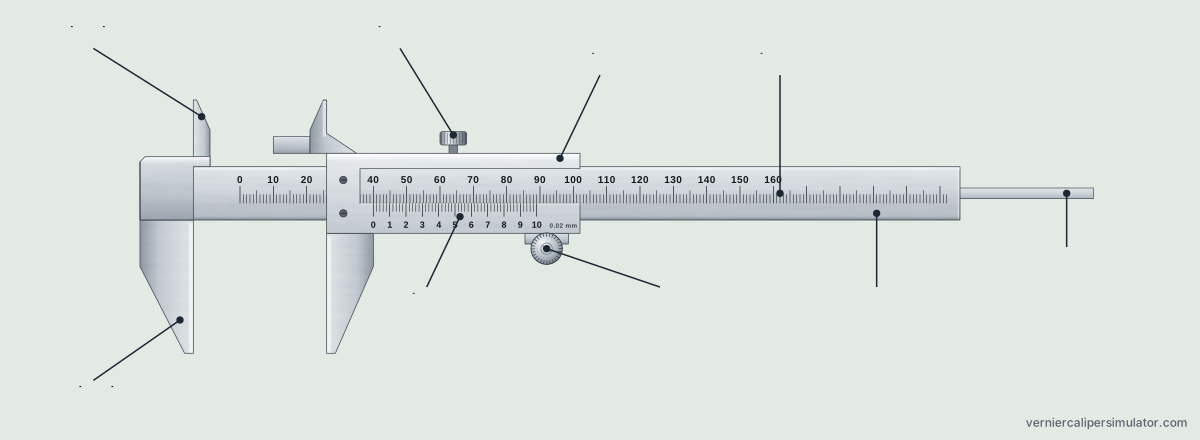
Parts and diagram
Labelled vernier caliper diagram with every part explained: outside and inside jaws, main and vernier scales, slider, locking screw, thumb wheel, depth rod.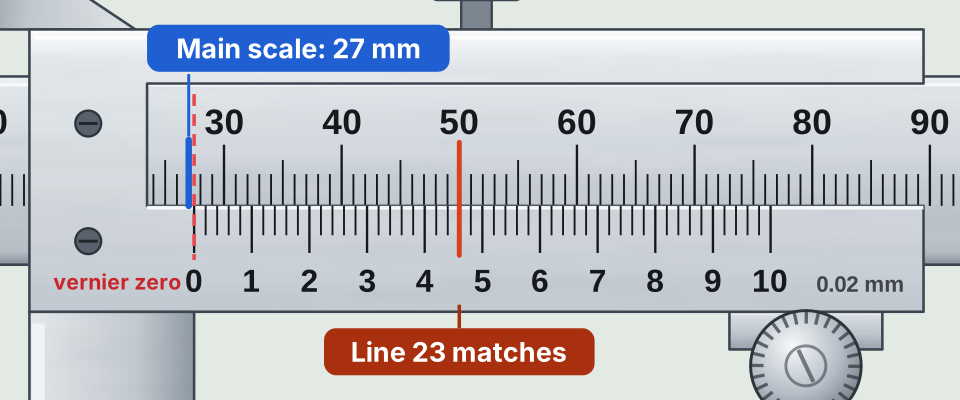
How to read
How to read a vernier caliper in four steps, with a worked example, metric and inch scales, least count, zero error, uncertainty and common mistakes.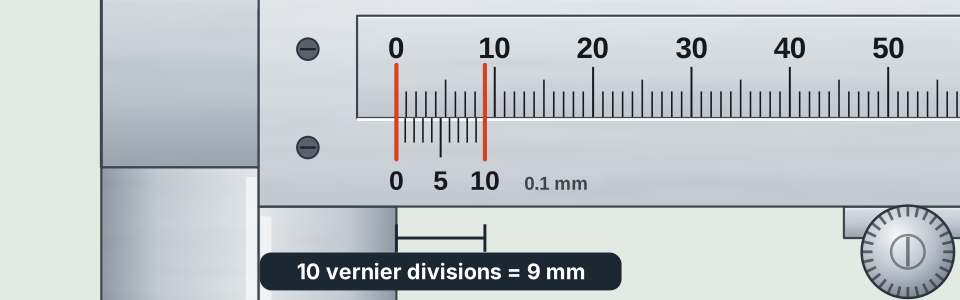
Least count
Find the least count of any vernier caliper: the formula, why it works, the least count of 0.1, 0.05 and 0.02 mm and inch calipers, and solved examples.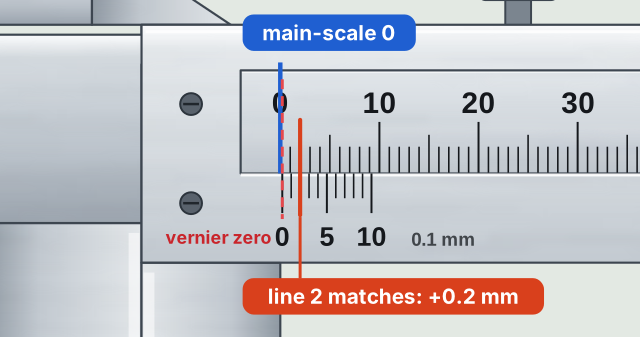
Zero error
What zero error is in a vernier caliper, how to find a positive or negative zero error, how to correct a reading, and solved examples on 0.1 and 0.02 mm.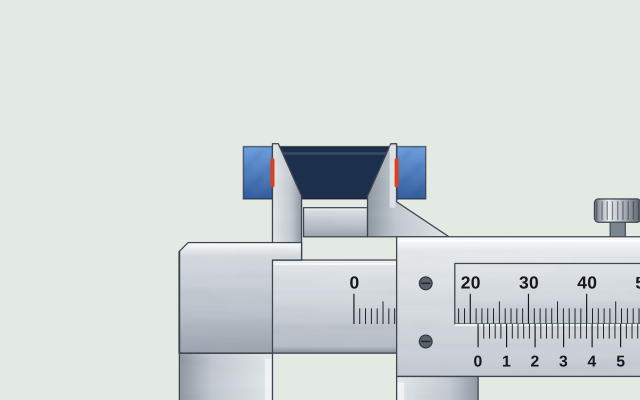
How to use
How to use a vernier caliper step by step: check the zero, measure outside, inside, depth and step sizes, read and record it, with a worked lab example.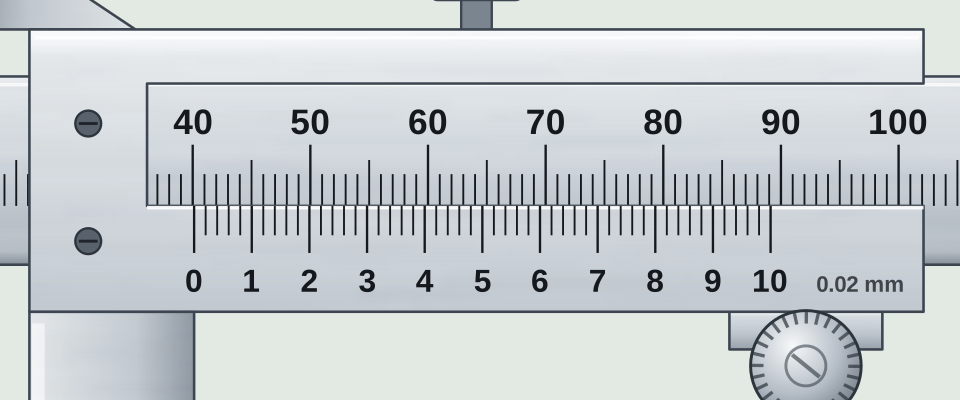
Reading practice
Twenty vernier caliper reading questions on 0.1, 0.05 and 0.02 mm and 0.001 and 1/128 inch scales, each with a hidden answer and full working.All guides: inch calipers, accuracy, digital vs vernier, micrometers and more.
How to read a vernier caliper
A vernier caliper has two scales: the main scale gives the whole divisions, and the short vernier scale shows how far past the last one the jaw has gone. Read it in four steps:
- Main scale. The last main-scale line at or before the vernier zero.
- Matching line. The one vernier line that lines up exactly with a main-scale line. Count lines, not printed numbers.
- Fine part. That line’s number times the least count.
- Add. Main scale plus fine part, then correct for any zero error.
reading = main scale + (matching line × least count)
For example, on the 0.02 mm caliper: 27 + (23 × 0.02) = 27.46 mm.
Read the full guide, with pictures of every step, inch calipers, zero error and common mistakes, or press “Show me how” in Measure to see each step marked on the scales.
What this model leaves out
This simulator models an ideal instrument. It does not reproduce measuring force: squeezing can deform a part or flex the jaws. It normally shows the scales straight on. The parallax demonstration is a simplified picture of what viewing them at an angle does, not a model of any particular caliper. Temperature can change the size of both the part and the instrument. Wear, dirt, damage and jaw alignment can also change the result on a real caliper.
Least count is not accuracy. It describes the scale’s reading increment, not a guarantee of closeness to the true size. Real measurements need suitable technique and an instrument whose condition and calibration are appropriate for the job.
About this vernier caliper simulator
A vernier caliper is a measuring instrument with two pairs of jaws, a main scale on a fixed beam and a short vernier scale on a sliding jaw. It measures outside sizes, inside sizes, depths and steps to a small fraction of the smallest main-scale division: a few hundredths of a millimetre, or a thousandth of an inch. It takes its name from the French mathematician Pierre Vernier, who invented the vernier scale in 1631.
This simulator puts one on your screen. The caliper above is drawn to scale from the same arithmetic that marks your answers, so every line sits where it would on a real instrument and every reading the site shows or accepts is exact for the scale in use. Drag the jaw, roll the thumb wheel, tighten the locking screw and read the scales through a magnifier, on a laptop, a tablet or a phone. There is nothing to install and no account to make.
Three ways to use it
Learn is six short animated lessons played by the caliper itself: meet the caliper, why two scales, read it in four steps, check zero first, measure real parts and avoid common mistakes. They have captions instead of a voice, questions along the way to check you are following, and you can pause at any moment and move the jaw yourself.
Measure is a measuring bench. Choose one of 18 objects, from a ball, a hex nut and a drill shank to the block, beaker and coin used in school practicals, and close the jaws onto it as you would in a lab. Outside, inside, depth and step measurements are all there. The true size stays hidden until you ask for it. Press “Show me how” and the walkthrough marks each step of the reading on the scales: the main scale reading, the matching line, the fine part and the total. Record each reading in the observation table, which works out the mean and its uncertainty, and copy the table into your lab record.
Practice gives rounds of five questions, from reading a coarse metric caliper to correcting for a zero error on an inch one. After each answer you see whether it was right and, when it was not, which slip you made: reading the wrong main-scale line, using a printed number instead of counting lines, being one line out, forgetting the vernier part, or applying the zero error the wrong way round. Switch on Exam to answer a set of questions with no feedback until the end, then print the result. A round can be shared as a link, so a whole class answers the same questions.
Every common scale
The simulator carries metric calipers with least counts of 0.02 mm, 0.05 mm or 0.1 mm, and inch calipers reading 0.001 in or 1/128 in, with a long vernier as well as the short one on the 0.05 mm, 0.1 mm and 0.001 in scales, measuring up to 150 mm on the metric scales. A metric main scale can be numbered in millimetres or in centimetres, as many school calipers are, and a zero error can be set in either direction to practise the correction. The method is the same on any vernier caliper, whoever made it, from a school lab instrument to a Mitutoyo workshop caliper: find the least count, usually engraved on the vernier plate, and choose the same scale here.
Who it is for
- Students preparing for the vernier caliper experiment in a physics practical, for example in Class 11, or for exam questions that show a scale and ask for the reading. The objects include the sphere, cylinder, block and beaker such experiments use.
- Trainees and apprentices in engineering and machining courses, who need to read metric and inch calipers quickly and without slips before they use one on real work.
- Teachers, who can show the caliper on a projector, mark each step of a reading for the class, set the same round for everyone with a link, and let students carry on at home with nothing to sign up for.
Vernier, dial and digital calipers
A digital caliper shows the measurement as a number on a display, and a dial caliper shows the fine part with a needle on a dial. Neither has a vernier scale, although shops often list digital calipers as “digital vernier calipers”. The manual vernier caliper needs no battery, and exams set questions on reading its scales, so the skill is worth learning even if you use a digital caliper at work. Knowing how the vernier works also makes it easier to spot when a digital reading cannot be right.
How accurate is a vernier caliper?
The least count tells you how finely the scale can be read, not how accurate the reading is. Accuracy depends on the condition and calibration of the instrument, how squarely and gently it is held, and the temperature of the part and the caliper. Each maker states the permitted error for each model; check that specification, and the calibration record, before relying on a caliper for work that matters. This simulator models an ideal instrument, so it teaches reading the scales, not the feel of the right measuring pressure. The limits are listed under What this model leaves out.
Vernier caliper, micrometer and screw gauge
A micrometer, called a screw gauge in many school textbooks, reads with a screw: one turn of the thimble moves the spindle by the pitch, and the divisions on the thimble split each turn. A typical school screw gauge has a least count of 0.01 mm, finer than a vernier caliper, but an outside micrometer measures only outside sizes over a short range, and inside or depth measurements need separate micrometers. A vernier caliper reads more coarsely, but one instrument takes outside, inside, depth and step measurements across its whole length.
More guides
Every topic above has its own guide, with pictures drawn from the simulator: see all guides.
Vernier caliper FAQ
What is a vernier caliper used for?
A vernier caliper measures lengths more finely than a ruler. One instrument takes four kinds of measurement: an outside size (the thickness of a plate, the width of a block, the diameter of a rod or ball) between the large jaws, an inside size (a hole or a slot) between the small jaws, the depth of a hole with the depth rod, and the height of a step with the end faces. Metric vernier calipers usually read to 0.1 mm, 0.05 mm or 0.02 mm, and inch ones to 0.001 in or 1/128 in. It is used in school physics practicals, workshops, engineering and inspection.
How do you read a vernier caliper?
In four steps. Read the main scale at the vernier zero: the last main-scale line at or before it. Find the one vernier line that lines up exactly with a main-scale line. Multiply that line's number by the least count. Add the two. On a 0.02 mm caliper: 27 + (23 × 0.02) = 27.46 mm. If the caliper has a zero error, subtract it at the end.
How many scales are on a vernier caliper?
Two that work together: the main scale, engraved along the fixed beam, and the vernier scale, the short scale on the sliding jaw. The main scale gives the whole divisions and the vernier the fraction of a division. Many calipers carry two such pairs, a metric main scale and vernier below and an inch pair above; read the pair for the unit you need, with that pair's least count.
What is the working principle of a vernier caliper?
On the usual vernier, each vernier division is made slightly shorter than a main-scale division. On a 0.02 mm caliper, 50 vernier divisions fill 49 mm, so each is 0.98 mm, 0.02 mm shorter than a main-scale division. As the jaw opens, every 0.02 mm of movement brings the next vernier line into line with a main-scale line, so the number of the matching line counts how many least counts to add to the main scale reading. That difference between one main-scale division and one vernier division is the least count. (A long vernier spreads its lines over about twice the length, each division a little shorter than two main-scale divisions; it is read the same way.)
What are the types of calipers?
Calipers that show a measurement come in three kinds with the same jaws, beam and depth rod: the vernier caliper, read from a main scale and a vernier; the dial caliper, whose needle on a dial gives the fine part; and the digital caliper, which shows the reading on a display. There are also simple calipers with no scale: outside and inside calipers, which pick up a size to be measured against a rule or compared with another part, and odd-leg (jenny) calipers, used mainly to scribe a line parallel to an edge. A micrometer, sometimes called a micrometer caliper, uses a fine screw instead of a sliding jaw.
How to calculate vernier caliper least count and reading?
First the least count: LC = value of one main-scale division ÷ number of vernier divisions. With 1 mm divisions and a 50-division vernier, LC = 1 ÷ 50 = 0.02 mm; with 10 divisions, 0.1 mm. Then each reading: reading = main scale reading + (matching vernier line × least count), for example 27 + (23 × 0.02) = 27.46 mm.
How do you calculate the total reading of a vernier caliper?
Total reading = MSR + (VSR × LC), where MSR is the main scale reading, VSR the number of the vernier line that coincides with a main-scale line, and LC the least count. Then correct for any zero error: corrected reading = total reading − zero error. For example, with a zero error of +0.06 mm, scales showing 27 + (26 × 0.02) = 27.52 mm give a corrected reading of 27.52 − 0.06 = 27.46 mm.
How do you zero a caliper?
It depends on the kind. A digital caliper: clean the jaws, close them gently and press the zero (or origin) button, so the display reads zero. A dial caliper: close the clean jaws and turn the dial bezel until the needle points to zero. A vernier caliper has no zero button, and you do not reset it before measuring: clean the jaws, close them gently and look at the two zero lines. If they do not meet, read the zero error with its sign, using the matching line, and subtract it from every reading. (On many calipers a repairer can reset the vernier plate, but that is a workshop adjustment, not part of taking a reading.)
Questions about the simulator
What is a vernier caliper simulator?
A vernier caliper you can use on screen. You move the jaw and read the main and vernier scales exactly as on a real caliper. This one also has short lessons, a measuring bench with objects to measure, and practice rounds with feedback.
Is it free? Do I need an account?
It is free, with nothing to sign up for. Open the page and start.
Which calipers can it show?
Metric calipers reading 0.02 mm, 0.05 mm or 0.1 mm and inch calipers reading 0.001 in or 1/128 in, with a long vernier as well as the short one on the 0.05 mm, 0.1 mm and 0.001 in scales, a main scale numbered in millimetres or centimetres, and a zero error in either direction.
Does it work on a phone or tablet?
Yes. It runs in the browser on phones, tablets and computers, and the jaw can be moved by touch as well as with a mouse or the keyboard.
Can teachers use it with a class?
Yes. Show it on a projector and press “Show me how” to mark each step of a reading for the class, or share a practice round as a link so everyone answers the same questions.
Can I use this simulator instead of a real caliper?
Use it to learn and practise reading the scales. It models an ideal instrument, so it cannot teach the feel of the right measuring pressure or reveal a worn or damaged caliper. Practise here, then confirm the skill on a real one.